CONTRAPPOSTO

Posted on Format Gallery

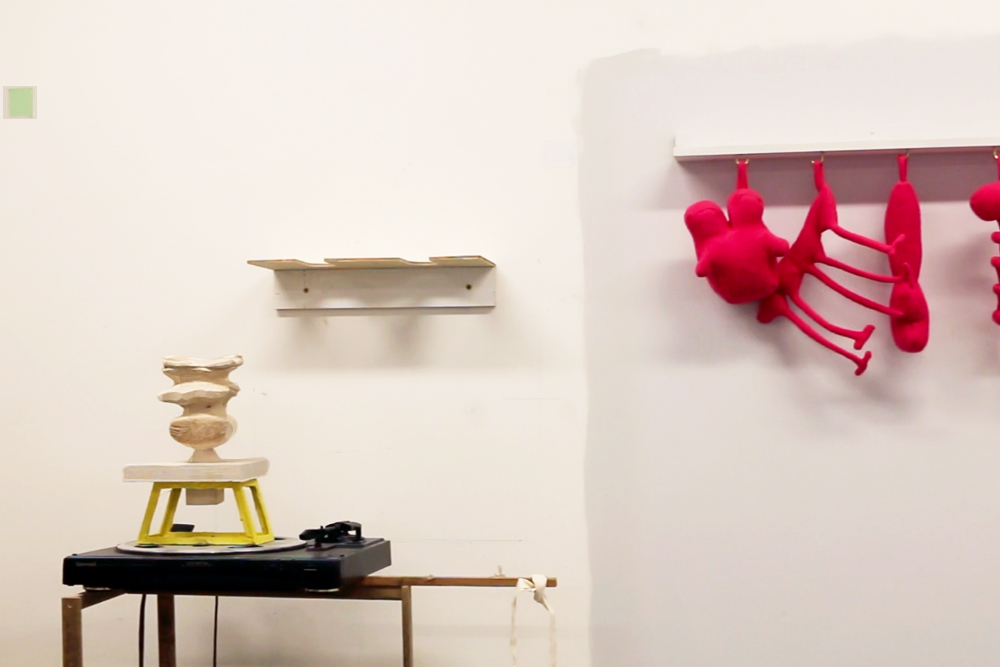
Contrapposto (4 mins) was made for the Isolation Room project during the Covid pandemic in summer 2020. Responses to a simple series of questions about working during lockdown appear as subtitles over a slow 360-degree tour of Dunhill and O’Brien’s densely packed studio. Maria Callas can be heard playing in the space alongside the steady noise of the motor driving the camera’s circular movement, while the deadpan account of studio life continues.
 
The film ends by returning to an image first explored during their British School at Rome residency in 2003, some seventeen years earlier, a bodily posture that gives the film its title, now revisited with the minor but perhaps telling addition of socks.


DOUBLE HAPPINESS COLLECTION

Posted on Format Gallery

In January 2023 curator Corina L. Apostol invited Dunhill and O’Brien to make new work for a two-person exhibition with Latvian-based artist Kristaps Ancans at Das Weisse Haus, Vienna. Apostol proposed the title Reverse Homesickness, drawing on the German word Fernweh — a longing for elsewhere, sometimes understood as the opposite of homesickness.
 
Dunhill and O’Brien began with an accidental fiction generated sixteen years earlier. For an exhibition made during a residency in Tokyo in 2007, they had written a press release in English which was translated into Japanese and subsequently translated back into English for the Tokyo Art Beat website. Somewhere in this chain the project became considerably more ambitious: instead of making clogs as mountain tools with which to model a clay form, the translated account appeared to describe the artists constructing an actual mountain landscape in the gallery and climbing it with homemade apparatus.
 
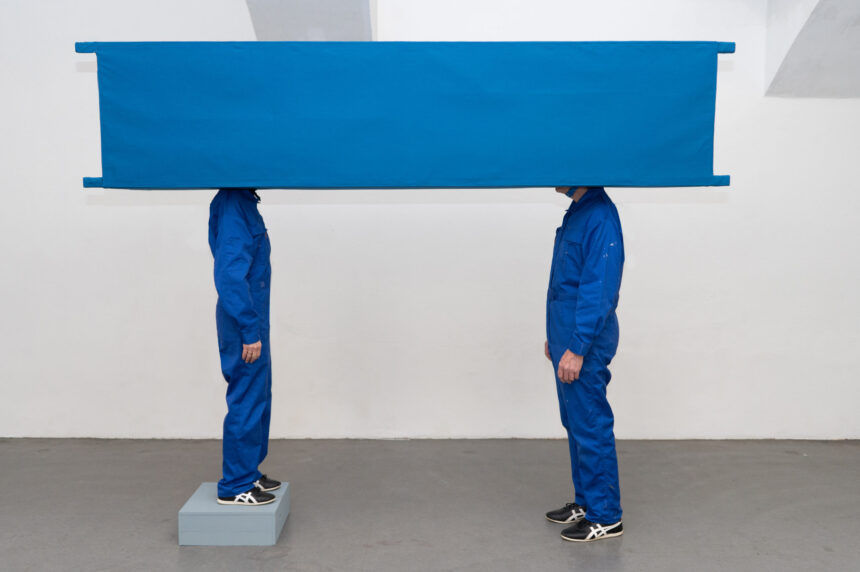
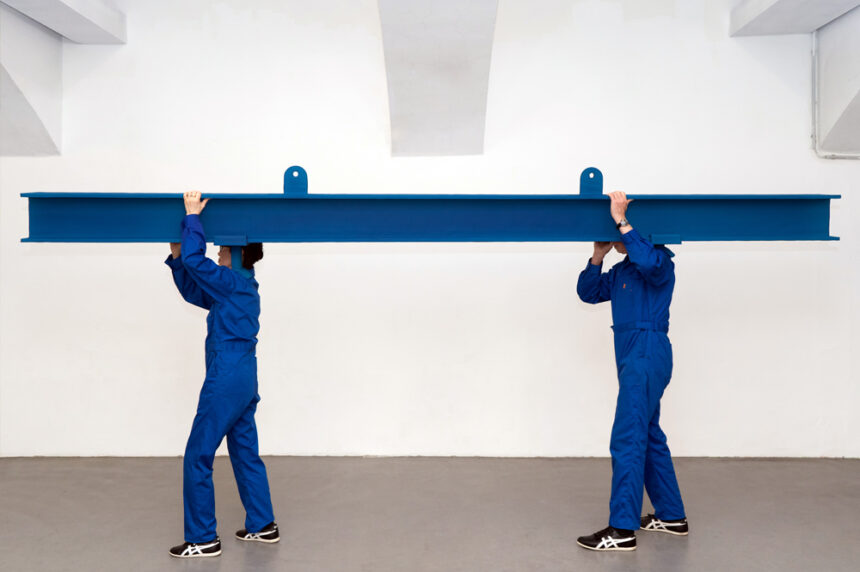
For Reverse Homesickness they decided to explore this mistranslation. The resulting works, shown from May to July 2023, were tailor-made to fit Dunhill and O’Brien and upholstered in a solid blue canvas. Designed to be worn, carried or otherwise put into service, they included improbable pieces of equipment for two increasingly comfort-conscious travellers: one work combined something of a stretcher, cupboard and seat, potentially allowing the pair to carry it to a view so they might sit down to better appreciate it.
 
Part implement, part accessory and part sculpture, these works formed the Double Happiness Collection. The title draws on the Chinese association of “double happiness” with marriage, while also borrowing the language of fashion collections, coordinated luggage and matching accessories. Their practicality remains questionable, but the possibility of transporting, wearing and using them is integral to their construction.
 
Meanwhile, Dunhill and O’Brien’s ongoing series of Stone Appreciation videos was shown on the gallery’s unusual collection of monitors, using every available screen regardless of size or quality. Differing in scale and distinctly boxy, each was mounted on a low platform trolley, giving the impression that the equipment had only just arrived or might shortly be moved elsewhere. Across the screens, Dunhill and O’Brien could be seen repeatedly measuring rocks — a series of methodical and faintly inexplicable activities.
 

Special thanks are due to Dr Corina L Apostol, Kristaps Ancāns, and the team at Das Weisse Haus. The project was supported by Das Weisse Haus.

SHOULDER SCULPTURE

Posted on Format Gallery

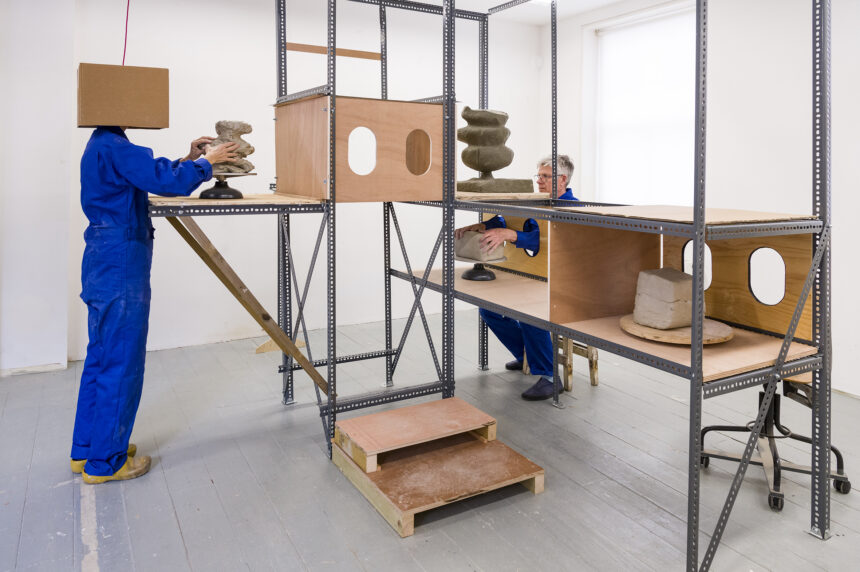
The Shoulder Sculptures are based on raw clay forms from earlier Dunhill and O’Brien works that no longer exist. Initially made for the White Conduit stand at London Art Fair in 2019, they were designed to be worn by the gallerist or invigilator as they moved through the fair, effectively turning the wearer into a mobile plinth.
 
Somewhere between sculpture, jewellery and harness, they were portable but not especially comfortable. When not being worn, they were stored in pairs on a shelf with their straps hanging below.
 
Each Shoulder Sculpture carries the memory of a much larger, temporary work, compressing it into something bodily, wearable and slightly burdensome.


Lost Work: Terms & Conditions

This Shoulder Sculpture derives from Terms & Conditions, Dunhill and O’Brien’s 2019 installation for the British Ceramics Biennial. The work included a 3.5-tonne raw clay form made in a single day, based on recorded descriptions of rocks by a dentist, dressmaker, boulderer, baker, engineer and masseur.
 
Throughout the exhibition the clay was kept damp so that it could later be redistributed. People arrived by car, bicycle, bus and on foot to collect bags of it for use in their own creative work.
 
Lost Work: Sculptomatic 2

For Sculptomatic 2 at Kunstvereniging Diepenheim, Holland, Dunhill and O’Brien worked with participants from the Netherlands and UK to make a 2.5-tonne raw clay form using locally sourced material.
 
After the exhibition, the clay was returned to the supplier for brick making.
 
Lost Work: Mountain Object

Mountain Object was made at the end of Dunhill and O’Brien’s first residency at Youkobo Art Space in Tokyo. Geta, or Japanese clogs, with platform soles based on two mountain ranges in the Nikko area, were used to model a clay mound on a turntable.
 
After the exhibition, the clay was donated to the residency’s materials store.
 
Lost Work: Sculptomatic 1

Sculptomatic 1 was a large-scale installation incorporating a 10-metre motorised elevator and 500 images of sculptures from different periods and cultures, all containing holes. Assistants made clay models from the images; each soft form was then placed on the moving structure and dropped from height into a vitrine, gradually accumulating into a two-tonne mass of raw clay.
 
After the exhibition, the clay was given to local art students.

POSTERS AND LIGHT BOXES

Posted on Format Gallery

Posters and Lightboxes records works in which Dunhill and O’Brien use flat, illuminated or printed surfaces to hold images, propositions and fragments of other projects.
 
Some operate as stand-alone works, others as compressed or re-presented versions of larger installations.
 
Image 1 Hide, 2023
Image 2 Shielding (Light Box), 2023
Image 3 Blockhead, 2003
Image 4 Blockhead 2, 2023
Image 5 Studio Scene, 2019
Image 6 An ABC of Holes in Sculpture, 2004
Image 7 Rome Studio, 2003
Image 8 Upholstered IBeam 2023
Image 9 PSERT, 2003
Image 10 Lost Works (Clay), 2004

STONE APPRECIATION: SELFIE

Posted on Format Gallery

Stone Appreciation: Selfie developed from Dunhill and O’Brien’s encounter with one of the Norber Erratics in North Yorkshire, a boulder they had previously measured, filmed and temporarily wrapped in blue tarpaulin.
 
From the front, the work presents a large, striking photograph of the wrapped boulder standing in the Yorkshire landscape, almost like a billboard or promotional image. Walking around it reveals a second version pressed awkwardly against the back: a padded, armature-supported form made from the tailored tarpaulin itself.
 
The work sets the image against its less poised material double. One is carefully framed, distant and self-possessed; the other is bulky, improvised and stubbornly present.

SMALLER SELFIES & ROCKS

Posted on Format Gallery

These smaller works operate as a kind of three-dimensional drawing within Dunhill and O’Brien’s practice. Some begin with rocks, landforms or earlier projects; others emerge from an ongoing interest in souvenirs, models and objects that stand in for something elsewhere or at another scale.
 
They are also part of a wider question about how sculpture might be documented. Rather than relying only on photographs, Dunhill and O’Brien sometimes make objects that retain, compress or reimagine aspects of a larger work or encounter. A large-scale installation might reappear as something more portable and manageable.
 
Their status remains slightly uncertain: part record, part proposition, part souvenir. That ambiguity allows ideas to persist, change format and proportion, and occasionally find their way into later works.
 

Images 1 and 2: Stone Appreciation: In the Morning

2019, 30 x 38 x 15cm

aluminium


Images 3, 4 and 5: Stone Appreciation: Okasan

2019, 28 x 20 x 15cm

lava Rock, MDF, felt, plywood

Photo: limited edition postcard, painted plywood stand with acrylic.


Images 6 and 7: Stone Appreciation: Otosan

2019, 30 x 50 x 30cm

flocking on jesmonite, vintage brown bowler hat, steel.


Images 8 and 9: Balanced Rock: Selfie

2019, 33 x 36 x 28cm

jesmonite, oil paint, aluminium, souvenir plate of Balanced Rock, Colorado.


Images 10 and 11: Brimham Rock: Upholstered

2019, 50 x 38 x 38

wood, mixed media and linen


Image 12: Mountain Geta

made as part of installation Yama to Ana 2007, completed as single work 2019

50 x 37 x 50cm

wood, fabric geta straps, jesmonite, wooden stool, acrylic sheet.
BOOTH

Posted on Format Gallery

In Stone Appreciation: Booth, visitors were invited to test the possibilities and frustrations of making collaboratively through clay. Two small screens on top of the booth showed a sequence of images of a free-standing erratic boulder.
 
Working in pairs, participants had twenty minutes to model a likeness of this complex natural form from a block of clay without seeing what they were doing or speaking to one another. A camera filmed the activity from the front of the booth. The resulting soft clay forms were displayed in a damp store/vitrine before being replaced each week by a new group of works, while a video of the modelling ran continuously throughout the month-long exhibition.
 
Feedback suggested that this wordless negotiation through clay could be both strangely intimate and absorbing. It also exposed frustration, rivalry and markedly different approaches to the task. Participants who had not previously met often described developing a sense of connection and camaraderie, while almost everyone reported a strong sense of shared ownership, pride and fascination in the final form — however ungainly, and however little it resembled the boulder that had prompted the collaboration.
 

This project was supported by research funding from the University of the Arts London.

STONE APPRECIATION III

Posted on Format Gallery

Rocks and stones are not always treated kindly. They are cast as dumb, unfeeling and burdensome: we find ourselves ‘between a rock and a hard place’, try to ‘get blood out of a stone’, or think of Sisyphus condemned to push his boulder uphill for eternity. Elsewhere, notably in Japan and China, rocks have long been objects of contemplation, veneration and pilgrimage.
 
Stone Appreciation III brings together videos of Dunhill and O’Brien drawing and measuring large boulders in British landscapes with films of their attempts to model the same rocks from memory. Working together in clay, they could see neither the form taking shape nor each other’s hands.
 
The task quickly became a strange form of negotiation. Hands occasionally collided; one person’s carefully resolved section might be turned away on the modelling stand and altered or erased by the other; each was repeatedly forced to make sense of a form they had not made themselves. The expansive business of clambering over, under and around a boulder in an effort to grasp its dimensions was translated into something smaller, more intimate and no less awkward: two people trying to construct a shared object by touch.


This project was supported by research funding from the University of the Arts London.

ERRATIC

Posted on Format Gallery

The geological term erratic refers to a boulder transported from its place of origin by glacial movement and deposited elsewhere, sometimes many miles away.
 
Dunhill and O’Brien first encountered an image of one particular erratic at the Natural History Museum in London. Struck by its improbable position, elevated on three small supporting rocks, they travelled to Yorkshire to find it. There, among an area of rocks seemingly scattered at random, sat the boulder on its limestone plinths.
 
Using blue tarpaulin bought from a local hardware store, they made a temporary skin for the rock. This was less a homespun homage to Christo and Jeanne-Claude than a way of taking possession of its form. Wrapped in the rolling Yorkshire landscape, the boulder appeared packed and ready for further transportation.
 
That journey continued, albeit as an image, to Ritsurin Garden in Takamatsu, Japan’s celebrated daimyo strolling garden.
 
Two works were made for an exhibition at the Sanuki Folk Craft Museum. In Erratic, an image of the boulder travelled at glacial speed along a narrow track running the length of the gallery. The movement was calculated so that, over the six weeks of the exhibition, the image covered the same proportional distance that the original erratic had travelled from its geological source. The scale of the image was likewise calculated in relation to the length of the track, at a ratio of 11:1.
 
Blue tarpaulin is widely used to protect objects from the weather. In the Takamatsu area Dunhill and O’Brien encountered numerous improvised uses of this ubiquitous material, documenting at least 78 distinct sculptural forms.


This project was funded by Tokyo University of the Arts, with special thanks to Professor O JUN, Associate Professor Yusuke Nishimura, Yoshinori Takakura, Kenta Kawagoe

ROCK

Posted on Format Gallery

In 1981 Isamu Noguchi completed Thunder Rock, a 15-tonne granite sculpture that subsequently crossed the Pacific three times in search of a home after its original commissioner in the USA was unable to complete the purchase.
 
When Dunhill and O’Brien encountered the sculpture in Yorkshire on a cold, windy day in March 2009, they were struck by the tension between Noguchi’s ambition to make an elemental form that might transcend the banalities of everyday life and the decidedly more prosaic business of repeatedly crating, shipping, storing and insuring fifteen tonnes of granite. The expanding carbon footprint and accompanying paper trail seemed a particularly poignant example of sculpture’s troublesome relationship with the practical world.
 
Invited some years later to make a temporary work for a park in Tokyo, Dunhill and O’Brien returned to Thunder Rock. Using photographs and written descriptions, they constructed a full-size transcription of the sculpture, tailoring distressed beige and cream leatherette to mimic its carved and uncarved granite surfaces. Unlike the original, their Rock could be collapsed and stowed as cabin luggage.
 
Something between an oversized Pakamac and an improbable sports holdall, Rock travelled Economy Class with them to Tokyo, followed by a visit to Noguchi’s studio and the granite quarry in Shikoku from which they believe Thunder Rock itself had been cut.
 
Back in Tokyo, reassembled and fully upholstered, the ungainly object was cautiously wheeled through the back streets of Nishi-Ogikubo, taking a convoluted route to avoid the steep hill between the studio and Zempukuji Park. There it finally came to rest for a month in a picturesque position overlooking the lake.
 

This project was made possible thanks to support from the Arts and Humanities Research Council and a research award from the University of the Arts London.